Confiscation of Landauer House and conversion into a biometric research center
The Glass RoomThe confiscation of Landauer House and its conversion into a Nazi biometric research center is a decisive reversal in the house’s history: a modern family home is taken from its Jewish owners and remade as an institution that claims to measure human difference. The change joins two forms of power. A decree strips the Landauers of ownership; research procedures then turn people into measurements, photographs, files, and punched cards, under the language of scientific neutrality.
Confiscation and the loss of home
The Landauers learn of the confiscation at breakfast, through a letter from their family lawyers in Město. The Swiss post has delivered it with the morning mail, normally laid beside Viktor’s plate. Liesel recognizes the letter’s unusual gravity before Viktor tells her that they no longer own the house. He passes the letter to her; without her glasses, its words blur. The news is not an abstract change in title but the sudden cancellation of the home around which their lives have been organized.
Viktor explains that the government has taken the property, and when Liesel asks why, he answers that it is because he is a Jew. The bluntness of that answer exposes the racial basis of the legal action. He then explains the new ownership to the children at breakfast: the house belongs to the so-called Protectorate, under a decree issued in the name of the Reich Protector of Bohemia and Moravia. When Ottilie asks whether that means Hitler, Viktor distinguishes the Protector from Hitler himself while making clear that he represents Hitler’s rule. The family’s domestic conversation has become a lesson in how persecution reaches into property and ordinary life.
From requisition order to research institute
The seizure is enacted through official documents and armed authority. Hauptsturmführer Stahl arrives to take possession, while the custodian, Laník, insists that the house is council property. Stahl presents the German-language requisition order as proof that everything is legal and above board. It names the transfer from the Municipality of Město and bears the signature of Karl Hermann Frank, Secretary of State of the Reich Protectorate. Stahl’s insistence on procedure does not soften the coercion: he tells Laník that they will enter one way or another, presenting acquiescence as the more peaceful choice.
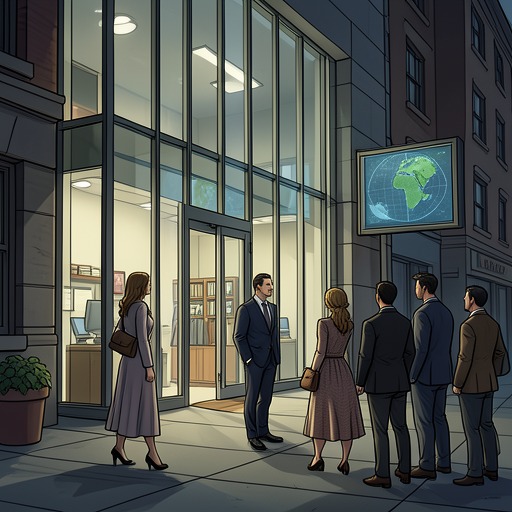
The next day, lorries deliver chairs, shelving, desks, and filing cabinets. Soldiers assemble a wooden guard hut inside the gate and put up a metal sign bearing a wreathed Nazi swastika: the Rasse- und Siedlungshauptamt, Forschungsstätte für Biologie. The private home has been formally renamed and physically secured as a state research site. Its new identity is announced at the entrance before the research routines within are fully established.
The house reorganized around measurement
The conversion works room by room. Upstairs spaces become offices, the kitchens are made into a laboratory, and the basement is prepared for an X-ray machine. A room that was already a photographic darkroom remains available for the new institution. Curtains divide the Glass Room, while anthropometric instruments are arranged in front of the onyx wall: scales, a height-measuring stand, and a steel device resembling a dentist’s chair, with rulers suspended above its headrest. Callipers wait on tables. Drapes and lights turn the dining area, with its semicircle of Macassar panelling, into a photographic studio; a Rolleiflex camera stands ready on its tripod. The Bösendorfer piano is the conspicuous survivor of the former household, maintained by a Jewish piano tuner even as the surrounding room is adapted to an entirely different purpose.
The garage also changes function. Heavy black machines made by Deutsche Hollerith Maschinen Gesellschaft mbH are unloaded into the space once occupied by two Landauer motor cars. One resembles a mangle; another, with a typewriter keyboard, is as large as an upright piano. The garage takes on the aspect of a print shop, with machinery humming and the smell of ink and ozone. Soldiers carry in boxes of files gathered in Vienna. The machinery and paperwork extend the institute beyond the immediate examination of individuals: they are meant to assemble a catalogue of human variation by processing records on a large scale.
Human subjects and the fiction of neutrality
People arrive by bus in groups of about twelve, separated by sex and roughly by age. The process is made to appear orderly rather than openly violent: staff direct the visitors politely, speaking Czech or German as needed. Stahl’s stated rule is that human subjects should be treated with the respect zoologists give animals. The comparison itself makes the institution’s view of its visitors plain: people are handled as specimens within a system that claims to observe them dispassionately.
The examination begins with a form recording date and place of birth, languages, religion, race, and nation, along with illnesses and conditions attributed to a person’s ancestry, including alcoholism, criminality, and mental retardation. Subjects are told the information is confidential and collected in the interests of pure science. They perform tests involving shapes and patterns, change into medical gowns, give blood through a needleprick, and have their blood pressure measured. The procedures lend the encounter the surface of a clinical appointment, but the information requested places identity, family history, and bodily condition within a racial filing system.
Measurements are standardized in minute detail. An examiner positions each subject at a stadiometer while a recorder waits with pen in hand; the subject’s heels, buttocks, and shoulder blades are aligned against a board, and the head is held so the chin is level. Height, hip and chest diameters, and limb measurements are recorded. In the chair, callipers measure the head and cranium. Staff assess skin colour against a von Luschan chart and compare actual eyes with rows of model eyes. Subjects are reassured that there will be no pain or discomfort, while the exactness of their positioning and classification is emphasized. The account calls this precision the cool gaze of scientific objectivity, but precision does not make the categories innocent or the examination freely chosen.
Data, political purpose, and the house’s afterlives
Stahl’s methods expose a tension between the institute’s scientific claims and its racial purpose. When Heydrich visits, Stahl acknowledges that Jews do not all have the diseases invoked by racial theorists, and that people with those diseases are not all Jews. Rather than accept that limit, he describes a method based on measuring minute variations in phenotype and searching for combinations that might yield a racial diagnosis. The Hollerith machines are to sort the accumulated data. The system’s own uncertainty thus becomes a reason to collect and classify more information, not a reason to abandon the premise.
The monthly returns reveal the administrative scale of the work. Stahl reviews figures for 672 people assessed in April, classified in categories including Slav, Aryan, and Mischlinge, with Roma and Jews accounted for separately in an addendum. He also requests the file for the Hanáková woman. The records are duplicated onto punched cards, boxed for a courier to Prague, and then sent to Berlin, where machines sort and assemble them at a rate of 150 cards per minute. The promise that patterns will reveal the keys to race and identity depends on converting individual bodies and histories into administrative data.
The confiscation is one stage in the house’s changing use, not its final one. Decades later, it serves as a children’s physiotherapy gymnasium, and a debate arises over whether a building considered an architectural treasure should continue to be used for treatment or be restored as a museum. The surviving onyx partition and the large, light-filled Glass Room recall the house’s modernist design, but they cannot by themselves restore the family life that was displaced or erase the period when the same spaces were arranged for racial examination. When the house is later described as a museum, its history remains unsettled: it has been a home, an appropriated research centre, a place of care, and an object of heritage claims. The conversion makes that history inseparable from the question of who controls a space and what its rooms are made to do.